
Organizational structures and project management
Every project exists inside an organization, and that organization has a structure. Whether it evolved deliberately or by accident, that structure determines who controls resources, how decisions get made, and how much authority a project manager actually has. Get it wrong and even well-planned projects hit invisible walls.
Organizational structures are one of the core environmental factors recognized by the PMBOK Guide. They shape resource availability, communication lines, and the degree of autonomy project managers enjoy. Although real companies rarely fit a textbook model perfectly, three classic types provide a useful framework for understanding how structure drives project outcomes.
Functional structure
In a functional structure, every employee reports to a single superior within a clearly defined department: accounting, engineering, production, and so on. Communication flows vertically, and each department operates as a self-contained unit.
Key characteristics:
- Authority rests with functional managers, not project managers
- Staff members report exclusively to their department head
- Departments can be subdivided into more specialized functional units
- Projects are framed within the boundaries of a single functional area
This model works well when projects stay within one department. The problems start when a project needs people from multiple functions. Since no formal project manager role exists in the hierarchy, cross-department coordination depends on informal negotiation and goodwill. Timelines slip, priorities conflict, and nobody has the mandate to resolve them.
In a functional organization, a project that crosses departmental boundaries has no single owner with authority over all the moving parts.
Organizations running a functional structure often benefit from a PPM tool that provides visibility across departments. When functional managers can see resource demand and capacity side by side, they can spot conflicts before they turn into bottlenecks, even without a dedicated project manager in each department.
Projectized (project-based) structure
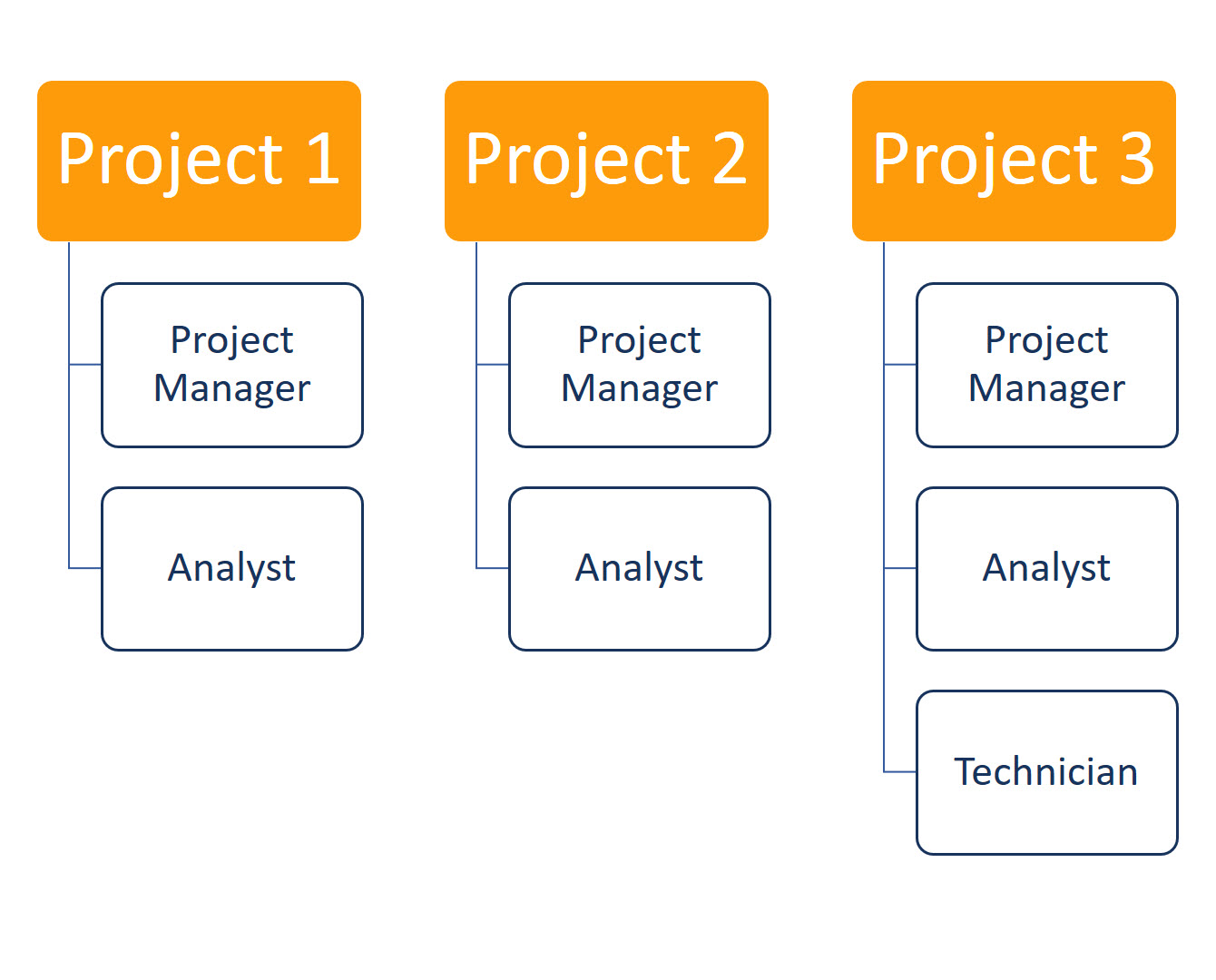
A projectized structure flips the functional model. Here, the organization is divided by project rather than by function. Each project gets a dedicated team and a project manager who holds real authority, often sitting at a high level in the organizational chart.
Key characteristics:
- The project manager has full authority over the team and budget
- Team members report to the project manager, not to a functional department
- Resources are assigned to one project at a time
- Departments, when they exist, are organized around projects
The strength of this model is clear accountability. The project manager owns the outcome. The weakness is equally clear: knowledge transfer between projects suffers. When teams are siloed by project, lessons learned in one initiative rarely reach another. The 9 barriers to knowledge transfer in project-based organizations are worth understanding if your company leans toward this model.
There is also a structural tension around resources. Since projects compete for limited financial and human capital, organizations using a projectized structure need a way to evaluate trade-offs objectively. Scenario-based project prioritization can help strike the right balance based on data rather than politics.
Portfolio-level oversight becomes critical in projectized organizations. Tools that let you group projects into programs by department or strategic objective, and then track financial performance and progress at the portfolio level, help leadership see across the silos that the structure creates.
Matrix structure
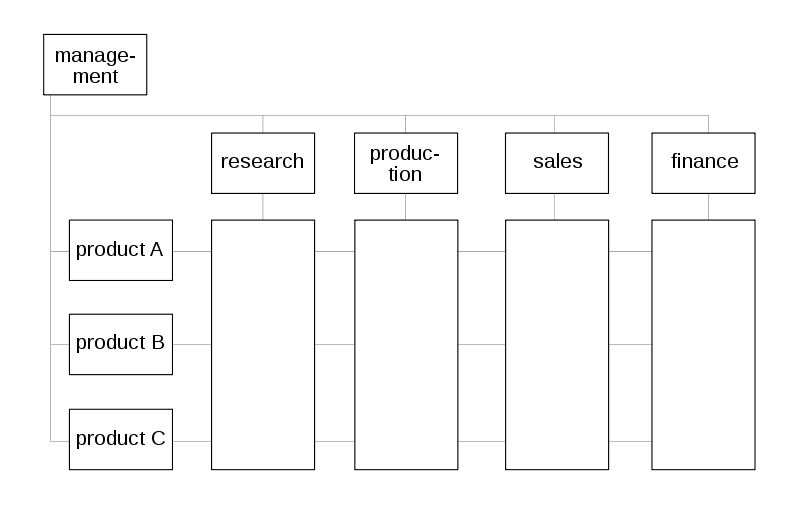
Matrix structures are the most common model in service providers and fast-growing organizations that run multiple projects simultaneously. They combine elements of both functional and projectized structures, with employees reporting to both a functional manager and a project manager.
The balance between those two reporting lines creates three variants:
- Weak matrix: Resembles a functional organization. The project manager acts as a coordinator or facilitator who can interact with all functional areas but cannot make binding decisions. Authority stays with the functional managers.
- Balanced matrix: The project manager has greater autonomy but does not control the project budget or make final resource decisions. Authority is shared, which requires strong communication and negotiation skills.
- Strong matrix: Closely resembles a projectized organization. A full-time project manager has real authority over the project, including budget and resource allocation, without dismantling the functional structure underneath. The PM operates at the same level as functional department heads.
| Variant | PM authority | Resource control | Best suited for |
|---|---|---|---|
| Weak matrix | Low (coordinator) | Functional manager decides | Organizations starting to formalize project management |
| Balanced matrix | Shared | Negotiated between PM and functional manager | Mid-maturity organizations with cross-functional projects |
| Strong matrix | High (full authority) | PM controls within project scope | Organizations running complex, multi-department programs |
The flexibility of a matrix structure is also its challenge. With two reporting lines, team members can receive conflicting priorities. A configurable role and permission system helps here: when a PPM platform mirrors real authority levels (giving coordinators visibility without edit rights, and empowered PMs full control), the tool reinforces rather than contradicts the organizational design.
Choosing the right structure
It is tempting to assume that matrix structures are always better because they correlate with more mature organizations. That is not always the case. The right structure depends on several factors:
- Nature of the activity: Repetitive, function-specific work fits a functional structure; complex, cross-functional initiatives favor a matrix or projectized approach.
- Corporate culture: An organization that values specialization and deep expertise may resist a projectized model that pulls people away from their departments.
- Customer demands: External projects with dedicated teams and fixed deliverables often suit a projectized setup, while internal programs with shared resources lean toward a matrix.
- Scale and growth: Fast-growing companies managing many simultaneous projects almost always end up with some form of matrix, whether they plan it or not.
Regardless of the structure chosen, the tooling should adapt to it, not the other way around. A PPM solution that supports flexible roles, cross-project resource planning, and portfolio-level visibility lets organizations evolve their structure over time without rebuilding their project management processes from scratch.
Next steps
- Explore how scenario-based portfolio prioritization can help your organization balance competing projects
- Read about the 9 barriers to knowledge transfer in project-based organizations
- Request a demo to see how ITM Platform adapts to your organizational structure
Try ITM Platform free for 14 days
Start managing your projects, resources, and portfolios today.