
Project life cycles explained: predictive, iterative, and adaptive approaches
You are two months into a software rollout and stakeholders are already asking for changes to the scope. Meanwhile, the construction wing of the same program is running a strict sequential schedule where a single shifted milestone would cascade across six months of work. Both are legitimate projects. Both need tracking, governance, and resource visibility. But forcing the same life cycle on both would guarantee failure in at least one of them.
A project life cycle is the sequence of phases a project moves through from initiation to close. The way those phases are organized, how much planning happens upfront, and how scope evolves over time define fundamentally different ways of working. Three broad categories dominate modern project and portfolio management: predictive (sometimes called waterfall or plan-driven), iterative and incremental, and adaptive (commonly referred to as agile). Each reflects a different assumption about how much you can know at the start of the project and how much you will need to learn along the way.
The choice of life cycle shapes scheduling methods, tracking mechanisms, team dynamics, and how you allocate resources and compare progress across projects that work in very different ways.
Understanding these approaches is not just a theoretical exercise. It is a practical decision that every project manager and PMO needs to make, sometimes on a project-by-project basis. Let’s break each one down.
Predictive life cycles: plan the work, work the plan
Predictive life cycles are the most established model in project management. They operate on a core assumption: the scope, schedule, and cost can be defined with reasonable confidence early in the project, and the team’s job is to execute against that plan.
Work is organized into sequential phases — requirements, design, build, test, deploy — where each phase produces a defined output before the next one begins. Gantt charts are the native planning instrument, with task dependencies (finish-to-start, start-to-start, and other combinations), milestones, and baselines providing the control framework. Because each phase tends to require different expertise, team composition often shifts as the project progresses.
Scope changes in a predictive life cycle are not forbidden, but they are treated as formal events. A change request triggers a review of the plan, an impact analysis on schedule and budget, and explicit approval before the new plan takes effect. This rigor is precisely the point: it protects the project from uncontrolled drift and gives stakeholders confidence in forecasts.
When predictive works well:
- The product or deliverable is well understood before work begins
- Regulatory or contractual requirements demand upfront documentation
- The cost of rework is high enough that getting it right the first time matters more than getting it fast
- Construction, infrastructure, compliance-driven IT deployments, and large-scale ERP implementations are typical domains
Where predictive struggles:
- Requirements are volatile or poorly understood at the outset
- Markets shift faster than the planning cycle can accommodate
- The technology is unfamiliar, making early assumptions unreliable
- Late-stage defect discovery becomes exponentially more expensive to fix
How progress is tracked in predictive projects
In a predictive life cycle, progress is measured by comparing actual performance against the baseline plan. Earned value management (EVM) is the classic technique: it triangulates scope, schedule, and cost into metrics like Schedule Performance Index (SPI) and Cost Performance Index (CPI) that tell you whether you are ahead or behind and by how much.
At a practical level, this means tracking task completion against the Gantt chart, monitoring milestones, and comparing planned versus actual effort. Setting a project baseline — a snapshot of the plan at a given point — and then visually tracking deviations gives project managers and sponsors a shared, objective view of how the project is performing relative to its commitments. When a critical path shifts or a dependency slips, the impact on downstream tasks is immediately visible.
Iterative and incremental life cycles: refine as you go
Iterative and incremental life cycles split the difference between full upfront planning and full adaptive flexibility. The core idea is that the project will pass through repeated cycles of work, with each cycle deepening the team’s understanding of the product and adding functionality.
The “iterative” part means revisiting and refining. Think of an architect who creates a rough sketch, then a detailed drawing, then a scale model, then construction documents. Each pass covers the same scope but at increasing fidelity.
The “incremental” part means delivering in pieces. Rather than building the entire product and releasing it at the end, the team delivers usable components progressively.
At the end of each iteration, a deliverable or set of deliverables exists that can be reviewed, tested, or even deployed.
These two ideas often combine: you refine the product through repeated cycles and you expand its capabilities incrementally.
When iterative fits:
- Objectives are broadly understood but details remain unclear
- The product is complex enough that early prototyping reduces risk
- Delivering partial value early is strategically important
- Think of the Spiral Model or the Rational Unified Process, both of which formalized iterative practices before the agile movement took hold
The portfolio angle. From a portfolio management perspective, iterative projects offer a natural “off-ramp” at the end of each iteration. If strategic priorities change or funding tightens, the project has already delivered something usable. This makes iterative life cycles appealing for portfolios operating under uncertainty, because they reduce the all-or-nothing risk inherent in a purely sequential approach.
Adaptive life cycles: embrace change as a constant
Adaptive life cycles — the agile family — start from a different premise entirely. Instead of assuming that requirements can be locked early, they assume that requirements will evolve throughout the project and that the life cycle should be designed to make that evolution cheap rather than expensive.
There are two fundamental patterns within adaptive approaches.
Flow-based models (Kanban)
Flow-based approaches do not use fixed-length iterations. Instead, work items are pulled from a prioritized backlog into an active pipeline, and work-in-progress (WIP) limits control how many items can be active at once. The goal is to optimize throughput and minimize cycle time — the elapsed time from when a work item enters “in progress” to when it reaches “done.”
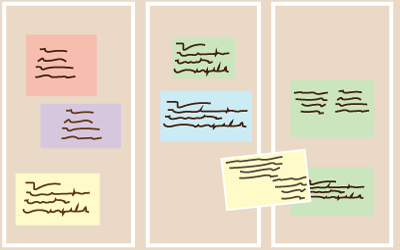
Kanban boards are the primary visual tool: columns represent workflow stages (e.g., To Do, In Progress, Review, Done), and cards move left to right. The board makes bottlenecks immediately visible. If the “Review” column is piling up while “In Progress” is empty, the team knows exactly where the constraint is. For a deeper exploration of how flow-based thinking compares to iteration-based approaches, see Kanban: why it’s agile and in what sense it overtakes Scrum.
Flow-based tracking uses the cumulative flow diagram (CFD), a stacked area chart that shows how many items are in each status over time. The CFD reveals WIP trends and cycle time without needing to define iteration boundaries. It is especially useful for teams doing maintenance, support, or continuous delivery where the work does not batch naturally into sprints.
Iteration-based models (Scrum)
Scrum and similar frameworks organize work into short, time-boxed iterations — typically one to four weeks — called sprints. At the start of each sprint, the team selects items from the product backlog and commits to completing them within the time box. At the end, the team delivers a potentially shippable increment and holds a retrospective to improve the process.
The burndown chart is the classic tracking tool here: it plots remaining work against time within the sprint, showing whether the team is on pace to finish everything it committed to. The expected line slopes downward from the total backlog at sprint start to zero at sprint end; the actual line shows real progress. When the actual line runs above the expected line, the sprint is behind; when it runs below, the team is ahead.
Burndown charts work best within a single sprint or a short project. For longer horizons, the cumulative flow diagram is more informative, because burndown does not handle scope changes gracefully — if new items are added mid-sprint, the chart can be misleading. For a practical look at how burndown and CFD complement each other in day-to-day tracking, see tracking projects based on agile methodology.
When adaptive fits
Adaptive life cycles shine in environments with high uncertainty, fast-moving markets, or products where user feedback is essential to shaping the outcome. Software product development, digital marketing campaigns, R&D exploration, and service design are all natural fits. The trade-off is that adaptive approaches require high stakeholder involvement — a product owner or sponsor who is available to prioritize, review, and provide feedback continuously.
Hybrid approaches: how modern portfolios actually work
The clean theoretical boundaries between predictive, iterative, and adaptive life cycles rarely survive contact with real organizations. In practice, most mature project portfolios contain a mix of approaches, and many individual projects blend elements from more than one life cycle.
A common pattern is the “waterfall with sprints” hybrid: the project follows a broadly sequential structure (requirements, design, build, test) but uses time-boxed sprints within one or more phases — typically the build phase — to deliver working software incrementally. This gives stakeholders the milestone-based visibility they need for governance while giving the development team the flexibility to adapt within each sprint. PPM tools that support enabling sprints within both waterfall and agile project types make this pattern practical: a waterfall project can overlay sprint cycles on its Gantt chart, and an agile project can filter its burndown and cumulative flow reports by sprint.
Another pattern is running a predictive project that includes an agile workstream. For example, a construction project (inherently sequential) might manage its software controls system using Kanban, with both workstreams feeding into the same portfolio view.
When a single platform normalizes tracking data across Gantt-based and board-based projects — showing completion percentages, budget burn, and timeline status in a unified dashboard — the distinction between “methodologies” becomes less about dogma and more about fit. For a deeper look at how organizations make this work day to day, see how to manage agile and waterfall methodologies together.
Choosing the right life cycle: a decision framework
Choosing a life cycle is not a one-time philosophical commitment. It is a project-by-project decision that should be made based on the characteristics of each initiative. Here are the key variables:
| Factor | Favors predictive | Favors adaptive |
|---|---|---|
| Requirements clarity | Well defined, stable | Vague, expected to evolve |
| Stakeholder availability | Limited involvement feasible | Continuous feedback essential |
| Delivery cadence | Single delivery at the end | Early and frequent value delivery |
| Regulatory constraints | Documentation rigor required | Flexibility more valuable than formality |
| Team experience | Comfortable with plan-driven work | Deep experience with agile methods |
Portfolio-level coherence. At the portfolio level, the goal is not to standardize every project on one approach but to ensure that progress, risk, and resource consumption can be compared across projects regardless of methodology. This requires a PPM system that normalizes tracking data — showing completion percentages, budget burn, and timeline status in a unified view even when the underlying projects run on Gantt charts, Kanban boards, or sprint cycles.
From theory to practice
The three life cycle families are not competing religions. They are tools, and the best project managers and PMOs know when to reach for each one — and when to combine them.
What matters in the end is not which label you apply, but whether your approach gives you the right balance of planning discipline and adaptive capacity for the specific work in front of you. The portfolio management challenge is making sure all of these approaches coexist productively under one roof, with consistent visibility for the people making investment and resource decisions.
Next steps
- Explore how agile tracking works in practice to see how burndown charts and cumulative flow diagrams support day-to-day project decisions
- Read about Kanban vs. Scrum to deepen your understanding of the two adaptive models
- Request a demo to see how ITM Platform supports predictive, agile, and hybrid life cycles in a single portfolio view
Try ITM Platform free for 14 days
Start managing your projects, resources, and portfolios today.