
Scaling agile to the enterprise with hybrid models
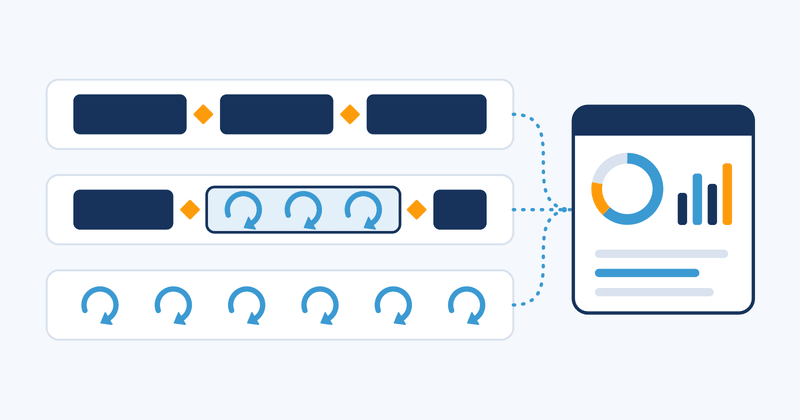
A company decides to “go agile”. Two years later its software teams plan in sprints, hold reviews and keep a backlog. Meanwhile the annual budget, the regulatory deadline, the supplier contract and the rollout to the branches still run on fixed dates, as they did before.
The company now has a hybrid model, although nobody designed one. Teams translate their progress by hand for the steering committee, gates ask agile teams for documents they no longer produce, and each side reads the other’s reports with some suspicion. Scaling agile principles beyond a handful of teams tends to stall at this point unless someone decides which parts of the organization adapt, which keep a plan, and how the two report to each other.
What a hybrid model is
Predictive management, often called waterfall, fixes scope, schedule and budget early and controls change against a baseline. Adaptive management, the agile family, fixes a cadence and a team, and decides what to build next at each iteration based on feedback from users. Most organizations need both, because their work contains both kinds of uncertainty: some of it is well understood and expensive to change late, and some of it can only be defined by trying.
A hybrid model combines predictive and adaptive practices in the same project, program or portfolio, and applies each one to the part of the work whose level of uncertainty suits it.
The Agile Practice Guide, published by PMI and the Agile Alliance and now in its second edition (2026), places agile approaches on a continuum of life cycles. Between fully predictive and fully adaptive sit iterative and incremental life cycles, which our article on project life cycles explains in detail. A hybrid model chooses a position on that continuum for each piece of work.
Which layers stay predictive and which adapt
In a large organization, the question “agile or predictive?” has a different answer at each level. Funding and contracts move at one speed and the daily work of a team at another. Looking at the organization layer by layer shows where a fixed plan helps and where it gets in the way.
| Layer | Usually predictive | Usually adaptive |
|---|---|---|
| Portfolio | Funding cycles, strategic priorities, capacity limits | Periodic re-prioritization of what is funded next |
| Program | External milestones, contracts, dependencies between projects | The order in which projects deliver within those milestones |
| Project | Phase gates, overall budget, release dates | Scope inside each release while requirements are still moving |
| Team | Commitments made to other teams | Planning and daily work, in sprints or continuous flow |
A few signals help decide which way a given piece of work should lean: how stable the requirements are, how expensive a late change would be, whether there are fixed external dates or physical and regulatory dependencies, and how much the result depends on feedback from users. Fitting out an office, with permits and suppliers, leans predictive. A customer portal that users have not seen yet leans adaptive. A single project can contain both.
Four hybrid patterns organizations actually use
In practice, hybrid models tend to follow a small number of patterns. They can be combined, and a large program often uses more than one at the same time.
Predictive frame, agile delivery
The project keeps its phases, gates, budget and end date, but the build phase runs in sprints. Analysis and approval happen up front. The team then delivers in increments and shows working results at each sprint review, and the closing phases, such as acceptance, training and handover, are planned as usual. It is an easy pattern to start with, because it changes how the team works without changing how the project is approved and funded.
For the pattern to spread beyond one enthusiastic project manager, sprints have to be available in schedule-driven projects as well as on boards. In ITM Platform, Waterfall (Gantt) projects can carry sprints, and the Gantt chart can be filtered and sorted by sprint. Sprints can also be enabled by default for a project type, so every new project of that type starts with them, as described in sprints.
Agile discovery, predictive rollout
When the solution is still uncertain but deploying it is expensive, the work splits in two. A small team iterates on a pilot or minimum viable product with real users until the design settles. The rollout to many sites, countries or customers then follows a plan with fixed dates, because it involves training, logistics and coordination with people outside the project. The handover between the two halves deserves its own gate, where the evidence from the pilot is used to approve the rollout budget.
Parallel workstreams under one plan
Some projects contain work that cannot iterate, such as hardware procurement, infrastructure or a regulatory submission, next to software that can. Each stream uses the approach that suits it, and the streams meet at shared milestones in one integrated plan.
Agile teams, predictive governance
Teams work in sprints or continuous flow, while funding, staffing and stage gates follow the organization’s quarterly or annual cycle. Planning is rolling-wave: the next quarter is planned in detail, and later periods only at the level of objectives and capacity. This pattern carries agile principles furthest into the enterprise, because many teams can adapt their work while finance keeps a predictable calendar.
| Pattern | Predictive part | Adaptive part |
|---|---|---|
| Predictive frame, agile delivery | Phases, gates, budget, end date | The build phase, in sprints |
| Agile discovery, predictive rollout | Rollout plan and dates | Pilot or minimum viable product |
| Parallel workstreams | Hardware, infrastructure, regulatory work | Software |
| Agile teams, predictive governance | Funding, staffing, stage gates | Team planning and delivery |
Running hybrid across a portfolio
Choosing patterns is the easier part. Running dozens of projects with different approaches in one portfolio raises three practical questions: who decides the approach, how progress is compared, and who is responsible for what.
Governance
Decide the approach when a project is approved, as part of its project type, instead of leaving each team to improvise. Adapt the gates to the approach: a gate for an agile team should review working results and evidence from users, since a complete specification written in advance is exactly what that team has chosen not to produce. Re-prioritize on a fixed portfolio cadence, so agile teams know when their backlog may change from above and predictive projects know when their baseline may be reopened.
A common language for progress
A board and a Gantt chart describe progress differently, and the portfolio needs both to mean the same thing by “in progress” and “done”. Agree on those meanings before comparing projects. In ITM Platform, task statuses in every project type derive from the same base statuses: Backlog, Pending, In Progress, Completed and Archive. Waterfall statuses are defined for the whole organization, and agile statuses per project as board columns, as explained in task status customization.
Each project is still read with its own instrument: schedule position against the baseline for a predictive project, flow and completed increments for an agile one. What rolls up to the portfolio is what both kinds of project share, which is budget, dates and progress. The ITM Platform portfolio lists every project and service, whatever its type, with Financial analysis, Schedule and Progress tabs and a portfolio dashboard, as covered in portfolio management.
Roles
Hybrid models blur some responsibilities, so it helps to name them:
- The project manager owns the integrated plan, the external commitments and the dependencies between workstreams.
- The product owner owns the order of the backlog and decides what each sprint delivers within that plan.
- The PMO sets the rules: which approach applies to which kind of work, what each gate reviews and how progress is reported. It does not need to impose a single method.
Common pitfalls
- Calling it hybrid when it is neither. Sprints with no review, no user feedback and no change in scope are a fixed schedule cut into short pieces.
- Asking agile teams for a full upfront specification at every gate, which gives them a reason to stop adapting.
- Reporting twice, in two tools or two vocabularies, so that every steering meeting starts by reconciling numbers.
- Judging agile teams by schedule variance, or predictive projects by velocity.
- Switching a project’s approach halfway without telling sponsors and stakeholders what will now be different.
Next steps
- Start a free ITM Platform trial and set up a project type with sprints enabled by default.
- See how programs and portfolio brings agile and predictive projects into one view.
- For the day-to-day side of running both kinds of team, read how to manage agile and waterfall methodologies together.
Try ITM Platform free for 14 days
Start managing your projects, resources, and portfolios today.