
Portfolio prioritization of innovation projects

Two innovation projects land on your desk. One promises a leap in customer data capabilities; the other modernizes an aging technology stack that quietly props up half the business. Both are expensive, both are uncertain, and only one can start this quarter. Which gets the green light, and how do you explain the choice to the rest of the executive committee?
This is the everyday reality of running a portfolio of innovation projects. The difficulties are well known: building a culture of continuous evaluation to validate hypotheses, coordinating multidisciplinary teams without prior playbooks, and accepting that most ideas will never reach the final stage. For the people who lead the innovation strategy, the biggest challenge is having a method that distinguishes the relative importance of each project so that the highest-value work is approved first.
Because the ratio between innovative ideas and projects that actually ship is so low, the cost of picking the wrong ones is amplified. Innovation projects are inherently inefficient: they need time and money for research before an idea is worth pursuing. That does not mean the spend should go unchecked. It means the portfolio needs a discipline that tolerates uncertainty without becoming a blank check.
Why innovation portfolios follow a lean philosophy
Innovation portfolios are usually run as a lean pipeline. Before a project enters execution, it lives as a proto-project: first an idea or hypothesis, then an MVP, then a series of pivot points. When the original hypothesis is not supported by real-world experience, or is only partially confirmed, the proto-project can be reoriented in light of what has been learned.
Pivoting adds cost. The search for commercial and technical viability is rarely linear, and innovative proposals have to be re-evaluated continually to decide which ones still deserve room to absorb that inefficiency and which ones should be cut so the overall investment stays sustainable. Grouping related initiatives under a single program with a shared budget and strategic objective is one practical way to keep this lifecycle visible at the portfolio level. ITM Platform’s program management structure is one example of how to formalize that pattern.
Innovation and corporate values
Innovation projects in large corporations usually respond to a vision that goes beyond the business itself. They also signal values such as corporate social responsibility, environmental sustainability, or the consolidation of an innovative culture.
Take BBVA. Its ambitious innovation strategy is centered on Big Data, with the ultimate goal of better understanding customer behavior to deliver better services. The effort is directed toward knowledge creation, and the key professional is no longer the traditional financier but the data scientist, who “is fluent in statistics, can program, and also understands the business.” The various initiatives that emerge from BBVA’s Big Data strategy compete for finite (though abundant) resources, which is why Marco Bressan chose to start by centralizing information.
The means any corporation has to materialize an innovation strategy is its portfolio of projects. For that portfolio to carry real weight, portfolio management has to be the explicit responsibility of a corporate unit, often the management committee itself.
General Electric is a familiar illustration. Its verticals run from aviation and transportation to software, healthcare, and water management.

A sample of the diversity in GE’s innovative portfolio
Because innovative projects are often completely new and very different from each other, it is hard to know which ones deserve preferential treatment. Is it more important that a project generates social return, or that it modernizes the technological infrastructure?
To answer that without falling back on opinions, leaders need an objective criterion for making complex choices.
Complex decisions are usually subjective
A complex choice is one in which the alternatives are weighted on more than one quality, so no single alternative beats the others on every dimension.
Picking an internet service provider is a good everyday example: price, customer service quality, line speed, and brand reputation all matter. Cheaper providers tend to be slower; more established brands tend to offer better after-sales service. The decision is never obvious.
These choices are made every day, and the final call is usually subjective because the decision maker does not have the time or the tools to figure out which option delivers the most value. That rushed quality is exactly what competitors exploit by appealing to emotion rather than to the service itself.
Whoever leads a corporate innovation program cannot afford that luxury. They have to justify their decisions, rely on data, and earn the commitment of many teams, often working in remote locations.
Portfolio prioritization with AHP
Without a technique to compare different value criteria, every choice between projects is as hard as choosing between ethical values like freedom and equality. There are dozens of prioritization methods for product requirements, but the project management world has far fewer.
The most useful method for the complex choices that innovative portfolios pose is AHP, the Analytic Hierarchy Process.
In short, AHP is worth using because:
- It helps build consensus around how to implement the innovation portfolio strategy.
- It is linked by definition to criteria, values, and business objectives.
- It shortens the political discussions.
- It increases commitment to the decisions taken, since every corporate criterion is represented in the right proportion.
The technique enables a side-by-side comparison of the relative importance of each criterion or objective. ITM Platform implements AHP using pairwise comparison and a Consistency Ratio check: see how strategic alignment is configured for a concrete walkthrough.
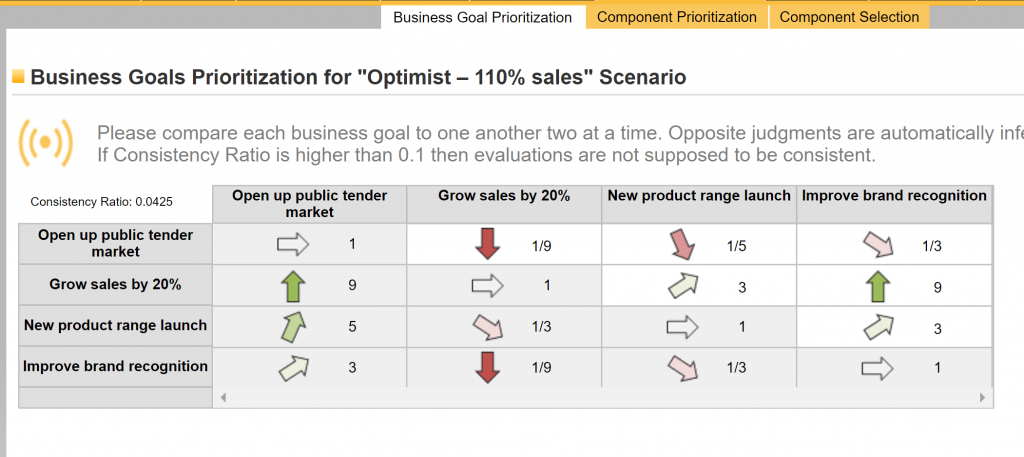
The resulting table does not hierarchize in absolute terms. It does not sort objectives from most to least important, because that would be an oversimplification. Instead, it surfaces the nuances that matter when comparing the diverse value propositions delivered by innovative projects.
Comparing innovation objectives
For an innovation portfolio, you might want to compare objectives such as:
- Improving the innovative culture
- Increasing market share in digital services
- Modernizing the technological infrastructure
Imagine the management committee dedicates a meeting to weighing these objectives in pairs and discussing which one matters most for the strategy. The conclusion would look something like the following table:

Although matrices can be filled in by hand or in Excel, it helps to have software that calculates the weights and is integrated with project management itself. A dedicated PPM tool stores the analysis, connects it to the projects under evaluation, and makes the rationale traceable for future reviews.
By linking each project to the objectives and criteria it supports, the tool indicates which projects contribute the most value and should start sooner. Evaluating each proposal is still a difficult art, just like crafting the proposals in the first place, with all the market scanning, trend identification, and uncertainty that entails. But there is a baseline of information management that can and should be expected.
The facilitated prioritization described here has the great advantage of generating consensus and supporting informed, renegotiable, and easy-to-communicate decisions. To go deeper into how innovative portfolios are built and governed in practice, the companion piece on management of innovative projects in private organizations is a good next read.
Next steps
- Explore how strategic alignment with AHP works inside ITM Platform.
- Read the deeper take on management of innovative projects in private organizations.
- Start a free trial and run your first pairwise prioritization against your real portfolio.
Try ITM Platform free for 14 days
Start managing your projects, resources, and portfolios today.