
Strategic alignment: Selecting the most valuable project portfolio for your business

Every organization has more good ideas than it can fund. Ranking client projects is usually the easy part: you back the most profitable ones and, if you have the capacity, you take them all. The hard decisions are the internal initiatives, the transformation and improvement projects whose value is real but far less obvious on a spreadsheet.
Choosing which of those projects to invest in is a strategic decision, and it should rest on objective data rather than on who argues most persuasively. In this article we look at why that decision so often drifts into subjectivity, and at a rigorous, transparent way to make it: selecting the project portfolio that contributes the most value to your business strategy, within the resources you actually have.
Why project selection drifts into subjectivity
When your income comes from delivering projects for clients, the criterion is clear: you prioritize the most profitable ones, and you take them all if resources allow. Internal projects are different. Their contribution to the business is less evident and much harder to predict, so investment decisions end up resting on perception.
The fact that an expected value is subjective does not make its effects any less real. It simply means the benefits are hard to forecast, and that promoters and managers fill the gap with judgment.
The classic tool for closing that gap is the business case, which asks promoters to express the value of their initiative in measurable terms, whether as increased sales or reduced cost. It helps, but it carries two well-known weaknesses:
- The human factor. A promoter is motivated to make their idea look profitable. Intrapreneurs are an asset, but their figures still need to be validated through a consistent, objective process.
- Limited vision. Each promoter sees their own area and defends their patch without weighing the whole. Management then compares business cases as if they had all been built to the same standard, which is rarely the case.
The real question is how to recognize, objectively, which initiatives will bring the most value once the projects actually deliver their expected benefits.
Value is bigger than profitability
A purely financial yardstick, comparing projects on forecast profitability in isolation, misses part of the picture. Two ideas are worth holding onto:
- A project’s contribution to the strategic plan can be broader than its profitability. A process automation project might return modest savings while strongly improving a priority goal such as customer quality perception.
- The whole can be greater than the sum of its parts. Some projects enable others, and a set of initiatives can create strategic value that none of them delivers alone. This is exactly why program and portfolio management goes beyond project management.
Managing projects strategically is the responsibility of the leadership team, and it should be enabled by the Project Management Office (PMO) whose objective is to maximize value, not only to coordinate work across the organization.
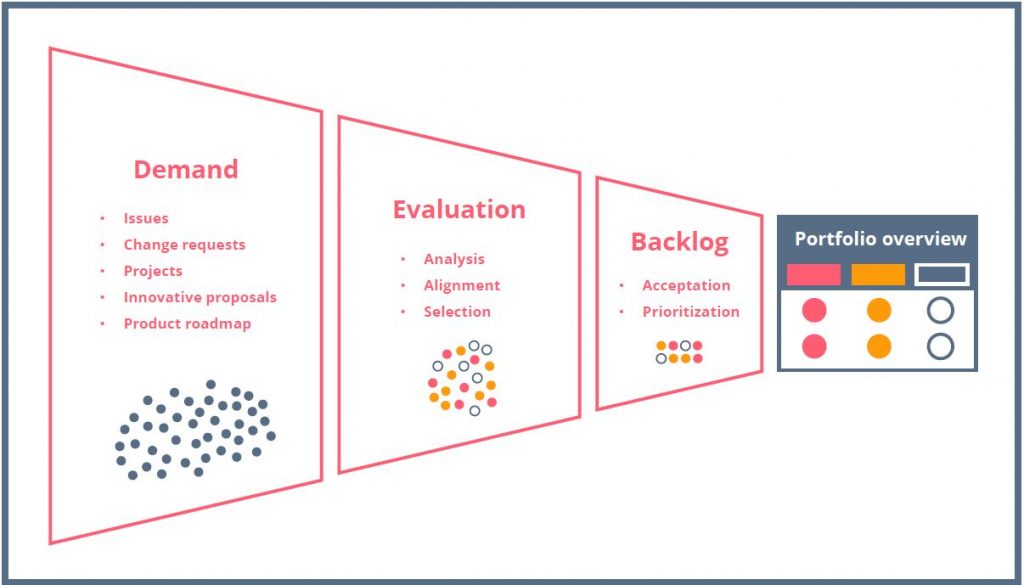
That leaves the approach resting on two inputs:
Strategic portfolio selection needs two things: a strategic plan that states the organization’s objectives, and a list of project proposals, the demand you are choosing from.
With those two elements you can prioritize initiatives from higher to lower value, producing an ordered list of approved projects, a portfolio backlog. The big advantage of ranking by value is that it lets you apply resource limits as a clean cut line: with an ordered list and, say, a budget ceiling, you approve the projects that contribute the most value and still fit within the money available. Prioritizing by value is also the backbone of any serious portfolio prioritization of innovation projects, where the return is uncertain and the ranking has to be defensible.
A repeatable process for choosing your portfolio
Once you have your objectives and your demand, you can run two classification exercises that can go in parallel or in sequence. What matters is keeping them separate, so each stays objective and easy to align with a common standard.
In ITM Platform this whole process lives inside a Program, which draws its objectives straight from your organization’s strategic plans, gathers the candidate projects as its components, and carries its own budget. The three steps below map to the Strategic Alignment view of that program.
Step 1: Prioritize your strategic objectives
Participants: the leadership team. Goal: rank the objectives and set the specific weight of each one on the total.
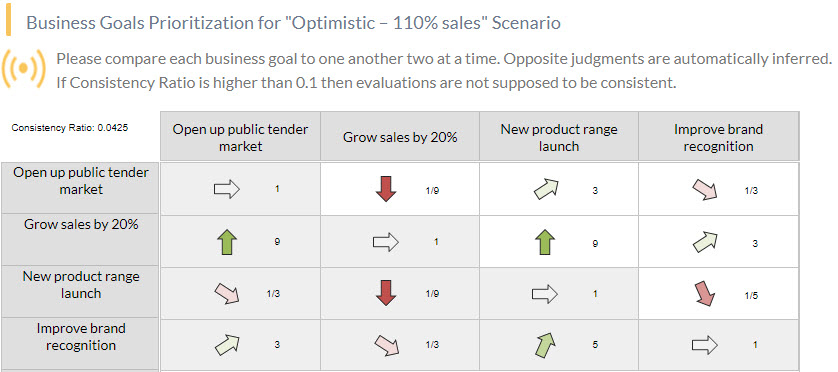
Sometimes a strategic plan already states priorities, but often it does not give an explicit weight per objective. How much more important is “grow sales by 20%” than “increase operating efficiency by 15%”? There are several techniques to answer that, and they sit on a spectrum from simple to rigorous:
| Method | How it works | Best when |
|---|---|---|
| Quantitative rating | Assign each objective a percentage of the total | You already have clear, agreed weights |
| Qualitative rating (Harvey balls) | Compare items visually with filled circles | You need a fast, intuitive read across many items |
| Pairwise comparison (AHP) | Compare objectives two at a time; the system derives the ranking | You want a rigorous, defensible hierarchy |
The most rigorous of the three, the Analytic Hierarchy Process (AHP), becomes simple to run with a pairwise comparison tool like the one in ITM Platform: you only ever judge two objectives at a time, and the system turns those judgments into an ordered, quantified list. It also reports a consistency ratio that tells you how logical the result is. A ratio above 0.1 signals that the judgments may be contradicting each other and are worth revisiting. If you want the detail, here is how that index is calculated.
Step 2: Score how much each project contributes
Participants: the project committee and the promoters. Goal: determine how much each project contributes to each objective.
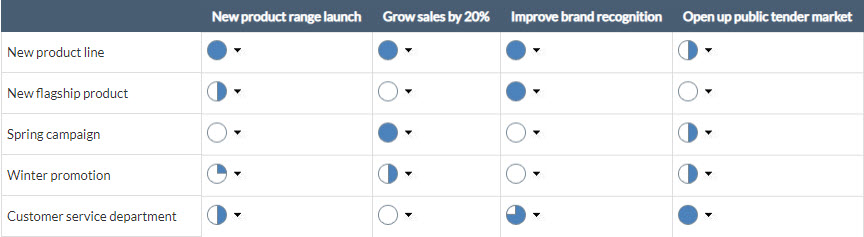
Setting aside for a moment how important each objective is, this step assigns a weight to each initiative’s contribution to each objective, expressed on a base of 100. You can use the same three methods as before: quantitative rating, pairwise comparison, or a qualitative read with Harvey balls, whose filled circles give an at-a-glance sense of fit. Keeping this exercise separate from Step 1, ideally with a different group of people, is what protects the process from bias.
Step 3: Select the optimal portfolio within your constraints
The two previous steps give the system everything it needs to calculate the value of each project, on a base of 100 and weighted by the importance of each objective.
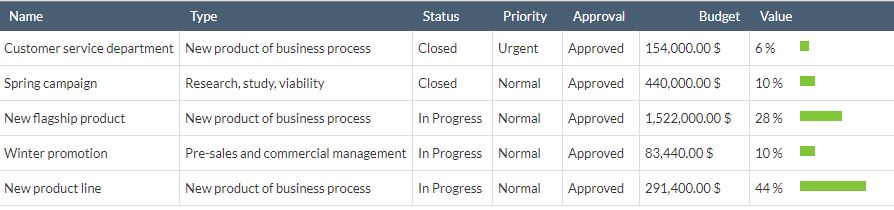
If money were no object, you would run every reasonable project. In a real organization resources are finite, so an ordered list of value is not enough on its own. You also need to filter for what fits your constraints, whether those are financial, technical, human, or time based.
Take budget as the most common constraint. Imagine you can spend no more than $900,000. On the list above, the “New Star Product” at $1.5M blows past that ceiling and contributes value similar to cheaper alternatives. Choosing the combination closest to the limit gets you three projects totalling $885,400 and 61% of the accumulated value.
That meets the criterion, but it is not the best you can do. This is where the efficient frontier earns its keep:
The efficient frontier is the set of portfolios that give you the most value for a given cost, or the lowest cost for a given value. Any portfolio below it can be improved: the same value for less money, or more value for the same budget.

And indeed, a portfolio of $528,840 reaches almost the same contribution of value for 35% less cost. ITM Platform surfaces this through three charts that guide the choice: value versus cost, the efficient frontier itself, and a comparison of the selected projects against your original business priorities, so you can confirm the portfolio still reflects the strategy you started from.
Reality rarely offers a single right answer, so it helps to model more than one. You can build optimistic, realistic, and pessimistic scenarios, each with its own budget and expected value, and set one as active for the program, then compare them side by side before you commit.
What a rigorous selection process gives you
You can apply rigorous standards to portfolio selection and base the decision on the value each project brings to the business strategy. Three things make it work:
- A clear division of labor between the leadership team that defines and prioritizes objectives, and the teams that assess the benefits of each project.
- A process sponsored by management that demands rigorous standards for investment decisions and enforces transparency between teams.
- An integrative platform that consolidates the information, exposes the results, and then follows the decision through, from the prioritized backlog into portfolio dashboards that show whether the projects you approved are still the ones delivering the value you selected them for.
Selected well, a portfolio is not a one-off spreadsheet exercise. It is a decision you can defend, revisit as conditions change, and track from strategy all the way down to delivery.
Next steps
- Start a free ITM Platform trial and build your first strategic alignment inside a program.
- See how the calculations work in the Project selection with scenarios guide.
- Keep reading: Guide to organize your project portfolio with scenarios.
Try ITM Platform free for 14 days
Start managing your projects, resources, and portfolios today.